
Frequently Asked Questions
About our Programs
-
Our goal is to provide an engaging and cooperative learning environment that supports academic growth, creativity, exploration, community building and connecting to nature. To do this we use a progressive, child-centered, constructivist approach that includes a variety of curriculum and activities selected for the age and needs of current students. Therefore, the approach and specific developmental approach shifts from year to year to ensure that individual student needs are being met.
In short, we use what works for the students we have at any given time and the specific approach shifts to ensure that we meet the developmental needs of all our students.
-
The Bridge School Program serves ages 5-11*
* Friday Creative Enrichment offerings serves Pre-K students ages 4-5, too -
Class sizes and specific age ranges vary year to year and can be anywhere from 8-15 students. When parents are helping in the classroom, the adult to child ratio can often be about 1:7. We value the flexibility provided by having smaller class sizes, all of which include an age range of at least two years.
Friday Creative Enrichment Workshops and summer camps generally range from class sizes of 10-15.
-
The Bridge School grew out of the co-founders’ experience at local cooperative preschools, so there are strong ties between the two models. Similarities include fostering a strong school community through having parents contribute to classroom and school needs and attending monthly parent meetings. Each family has a job such as Marketing Lead or Teacher Support and we organize families into School Support Teams responsible for a particular list of tasks (e.g. Fundraising, Facilities, Marketing, etc.). There are no set hours of required volunteering; instead each family fulfills their primary School Job and supports other teams as needed.
As we have grown, we have adapted our cooperative model to meet the needs of elementary ages through more targeted classroom roles for parents and many opportunities to help the school outside of school hours. Families who choose The Bridge School want to be involved in their child’s school and education. This high level of parent involvement not only builds a strong, friendly community but helps keep our tuition the lowest of any comparable schools in the Seattle area.
.
The choice to follow a cooperative model is independent of the curriculum and has been effectively used in a variety of schools for all ages including public education, Montessori schools and independent models. -
Purposeful experiential learning uses high interest games and open ended activities to allow children to explore ideas and materials, solve problems and express themselves and their thinking. Learning that is hands-on and involves play is not only natural, but sets the stage for future learning through intrinsic motivation and greater social-emotional success.
Our teachers plan and create challenging, dynamic, experiential learning opportunities in the classroom for all ages of students, but particularly for our younger classes.
-
We understand that families have a variety of needs and preferences for their child’s education, which is why we offer a flexible program where your child can attend either four or five days per week.
The Elementary School Program meets Monday – Friday mornings and includes regular instruction in math, literacy, science, social studies, music, art, outdoor education and social-emotional skill development.
Friday Creative Enrichment is part of our Elementary Program and offers optional morning workshops on a variety of topics including (but not limited to) Musical Theater Production, theater skill development, visual arts, building/construction, physical education, sewing, and songwriting. It is open to Homeschool Families, as is Cedar Play School. There are two sessions for Friday Creative Enrichment classes and students may enroll in one or both sessions.The Elementary School Program provides 1000 instructional hours, which meets the minimum requirement for a Washington State Approved School.
-
We believe that there are unique benefits to multi-age classrooms including allowing students to grow at their own pace in a non-competitive environment and deep peer-to-peer learning and mentorship. Many teachers have the same students for more than one year, which allows teachers to deeply understand their students and develop strong, trusting relationships. Student growth and assessment are built into the daily teaching and learning so that teachers are ready to support the next steps.
For more information on multiage classrooms, check out the following resources:
“The Multiage Classroom,” article by Marion Leier
Multiage Q&A: 101 Practical Answers to Your Most Pressing Questions, by Jim Grant, Bob Johnson & Irv Richardson
The Multi-Age Classroom: A Family of Learners, by Wendy C. Kaston & Barbara K. Clarke
Exploring the Multiage Classroom, by Anne A. Bingham
-
If your children are close in age, they may be in the same class. However, that doesn’t mean that they will be spending all their time together or working at the same level. Instruction in multi-age classrooms is differentiated based on student abilities; while the subjects or themes are the same for all students, the level at which they are working varies based on their development.
-
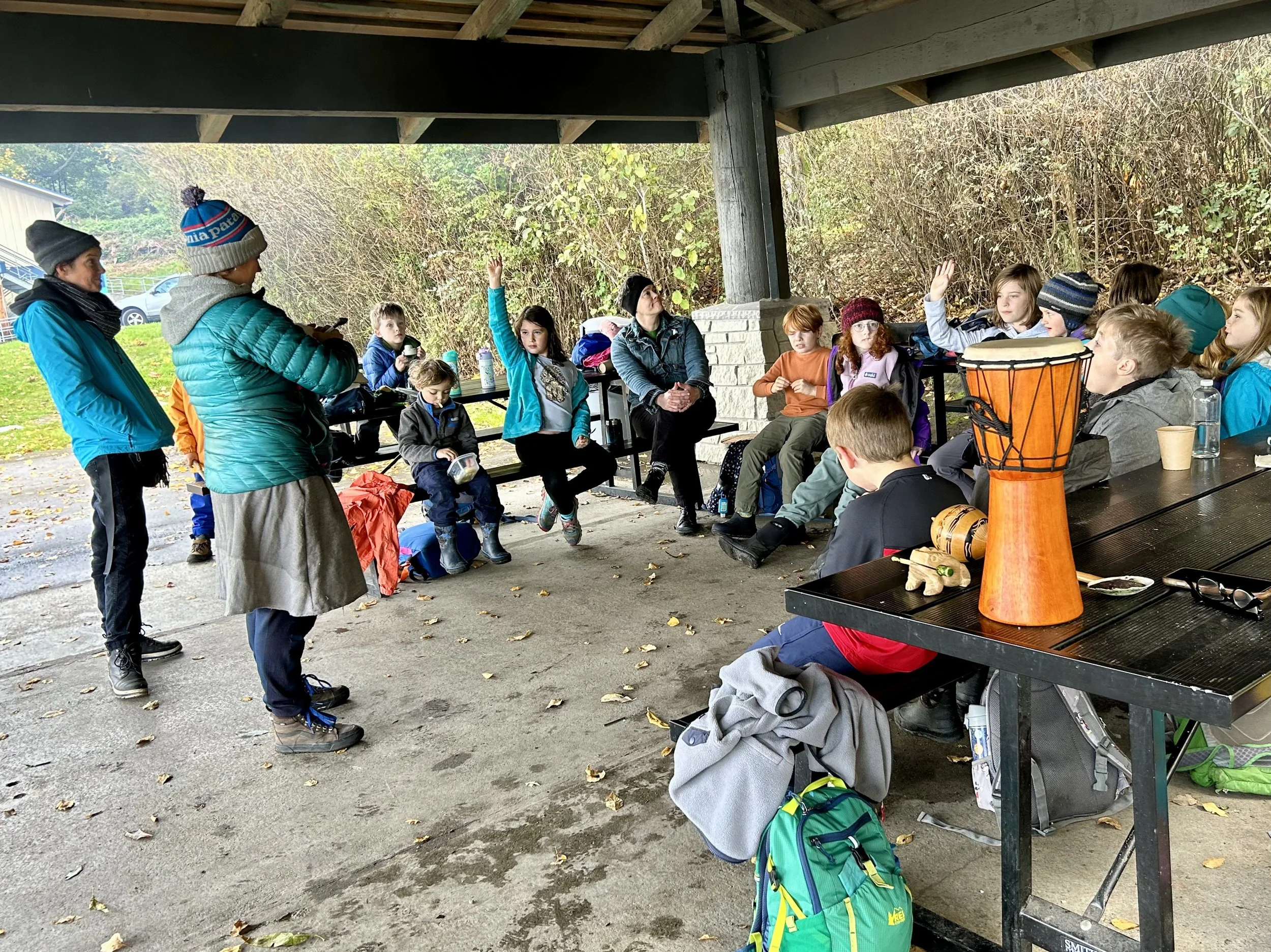
Broadly defined, outdoor education is experiential learning in, for, or about the outdoors. At the Bridge School, part of our curriculum includes regular Outdoor Education classes with outdoor education instructors. The whole school spends one day a week at Seahurst Park learning how to be naturalists, how to live and thrive in nature, and how to be good stewards of our natural world.
Early goals of our outdoor education program is to normalize being outside by support students in feeling comfortable exploring the outdoors with guidance; as they get older they learn skills in observation, journaling, plant and animal identification and earth science.
-
Yes! We believe that it is important for students to have learning opportunities that are real and extend beyond the four walls of the classroom. Learning happens all the time, whether students are in school or in the classroom. Teachers plan multiple field trips and experiences throughout the year to illustrate and experience current projects and topics of study (and we also love going to the theater when we can, too!).
-
We do not assign regular homework at The Bridge School. However, work will be sent home on occasion if not completed during class or if a student needs additional support in a particular area. We believe children should be able to spend lots of time outside of school with family, friends and pursing their other interests. If students or parents desire academic resources to pursue at home, teachers will be happy to suggest appropriate learning materials and games to reinforce learning.
-
All students have morning recess plus an hour for lunch and mid-day recess.
-
Yes. We’ve had students successfully transfer to both public and private schools at grade-level. Our instruction and assessment are based on developmentally appropriate practices, and our main focus is to meet each child where they are academically and socially.
About Student Assessment
-
We use a variety of assessment tools including observation, Developmental Continuums, Running Records, DIBELS, and narrative descriptions. We are also reference WA State standard standards. We do not use standardized testing or grades at The Bridge School.
Our low student-adult ratio and multi-age classes allows teachers to know students individually. Students are assessed with an eye toward regular progress and skill development, rather than achieving specific grade-based benchmarks, and each student is tracked to ensure that he or she is appropriately supported and challenged. Each student has an annual portfolio of work samples that are collected over the course of the year; as student get older they take a larger role in selecting work to contribute to their portfolios.
Teachers and parents discuss student progress at Fall and Spring conferences during the year, in addition to regular weekly and monthly communication.
-
We believe each child comes to us right where they need to be. Current academic level or ability has no bearing on admittance. That said, it’s important that we have as much information as possible so that we can determine if The Bridge School is a good overall fit and, when it is, to determine class placement. To gather information, we require that applicants submit an evaluation form completed by their current teacher, as well as either attend a scheduled Play Date Observation (ages 5-6) or visit the school for a morning. If an applicant has not had a prior teacher, we ask that another adult who knows your child well complete this evaluation. We may also assess incoming students so we can support and challenge them at an appropriate level.
About Family Participation
-
The Bridge School values a strong school community and that is only possible if families have a desire to participate. We ask for parent help in areas such as classroom support, cleaning, fundraising, membership, driving for field trips etc., and each family fulfills an assigned School Job, arrived at in consultation with each family about their skills, passions, and capacity.
-
Yes! We always have students whose family schedules do not allow for availability during the school day or form whom working in a classroom is not the best fit. We work together to find meaningful ways for your family to contribute to the community.
About Student Support
-
We determine our ability to serve students on an individual basis. As a small school without a long list of specialists, we are not able to offer special services for severe learning disabilities and may or may not be able to meet other student needs around behavioral challenges. In admissions decisions, we strive to make sure Bridge is a school environment in which your child can thrive. We have found that students who require high levels of one-on-one attention and more structured environments may be better served in settings that can provide that support.
-
Yes. All children are eligible for services within their local school districts regardless of where they attend school.
-
Our small class size allows teachers to tailor assignments to a student’s needs, whether they need extra support or greater challenge. Our multi-age classrooms allow students to work at their level, regardless of their age or “grade.”
Other Questions
-
Yes.
-
We do not currently offer onsite before- or after-school care. We occasionally offer after school clubs focused on particular student interests.
-
Yes, we offer financial aid for our Elementary School Program families.
-
We holds several open houses during each year where caregivers can visit the classrooms and talk to teachers and current parents. Interested families can also reach out at any time for private tours of the school. We suggest you first complete the Inquiry Form and our Head of School will reach out soon to schedule.
-
Yes. Please contact us to schedule a tour or if you have questions or requests for information: amanda@bridgeschoolcoop.org